Sunday, 18 October 2015

Thursday, 15 October 2015
Wednesday, 14 October 2015
180 Degree Rule
The 180 degree rule is the rule that helps maintaining continuity in shot by separating the shot in half and only using 180 degrees of the shot. in doing so you will never get other cameras and camera operators in shot and the continuity will be maintained.
Monday, 12 October 2015
Friday, 9 October 2015
Monday, 5 October 2015
Webserial Production Report
Lwhen making my web series in the pre production stage there is a number of thing i need to make are done are are being done so that i can stick to my deadline but also so i can make sure i have all the equipment to record, not to forget the the plan, storyboard and locations. i also need to make sure i have a planned budget that i will follow to so that i don't go over, but making sure i have everything i need.
Type of Production
this is going to be a web series which is of the teen drama/thriller genre. this will be targeted at the youth audience ranging from about 13-18
Finance
when it comes to finance i will be given a grant from a private investor who is close to myself. once i receive the grant i will split it up so it can pay for Equipment, transport, talent for example actors, crew (production team), materials, facility hire for example studio and edit suite time.
The equipment including cameras along with operators, boom mics alone with their operators. Also i need arrange transport for all the equipment and the people working it to get from location to location using a service called uber where i can send the cab via an app that is easy to use and easy to manage. i will be booking out an editing suite called digital snowball where i will edit the whole webserial.
Time
Everything should and will have a deadline that i will try my best to stick to so that i insure that it is finished by the designated time given to me. Everything so and will have a time frame so for example if editing is going to be for one day i will book the suite for one day and one day only everything should be done, same with filming if filming is meant to be for 3 days i need to make sure there is transport for those 3 days so that it will not exceed that deadline i set for that part of the production stage.
Crew and Personnel
the crew will not be big due to the budget i have made so there will be one camera operator, one boom mic operator, one location manager and so on the only thing i will have multiple of is the actors that are taking part. Also because it's a we serial it's not a big production as there's not to many people ended in the production.
Facilities
In this part I will be creating a list of equipment I might need in the post production, production and pre production stage of in my web serial.
So the kit list would have things like :
for the production stage:
Camera
Camera
Tripod
Boom mic
Lights
Reflectors
Tracks
Dollys
For the post production stage:
Imac
Final cut Pro x
Compressor
For the post production stage:
Imac
Final cut Pro x
Compressor
Materials
In some parts of the episode there will be diegetic and nondiegetic sound and music that will be edited in after and some of it will be copyrighted so that will mean that i will have to pay for clearance to use it so that i will not breach the copyright act 1988. So looking at the bigger picture i will be easier for me to source out music and sounds that are not copyright protected, so that i avoid paying large amounts of money on one piece of music.
contributors
the cast (Actors) will be sourced from the nearby acting collage so this mean i don't necessarily have to pay them because i am giving them an opportunity to not only learn on the job but to put all they have been leaning into a real film that will be posted on youtube, in doing that i am providing a platform for their future career.
Locations
locations will be sourced out by the location manager who will try to find locations that don't need to be paid for for example a local park or maybe even a school but they might need permission from the local authority and also the members of that public that are living in that area. also because it is a single camera production film there will be no need for a big location so size does not matter, thus making it easy for the location manager. Also on all the locations chosen a risk assessment will have to be carried out.
Codes of Practise and Regulations
When doing the final edit i as the producer will need to make sure that there is no copyright protected material in the film that has not been paid for or cleared. Gaining the local council's permission should happen and be settled at least 2 week before so that we are able to film with no quarms. A risk assessment will be carried out on all the locations to make sure that everyone is safe and it is okay to film in that condition. The local police will need to be informed that filmmaking is happening due to the fact that we might be filming a scene where someone is being provoked by a weapon they will not see it in the wrong way. Also we need to make sure that we have the public liability insurance which will protect you if any of the crew or any member of the public get hurt or property gets damaged while you are filming. Lastly while making the film i need to keep in mind what certific i want to give the movie so i can work towards that and when it comes for me to give it into the bbfc i will not have any quarms about making cuts in the film.Wednesday, 23 September 2015
Format and Narrative Report
When filming series, serials and single dramas, there are different camera techniques that are used to create different feeling, emotions and too help us see relationships and relevance on scene.
A Single camera production is a form of recording where you are only using one camera at any point in time of recording. This type of production allows the director and production team to plan every shot frame by frame and allows them to record and record to there liking because of the fact that only using one camera is much, much cheaper and they are able to use the camera man more effectively. Single camera production has a lot perks when using single camera production for example because its single camera you don't need a big location and most locations small or big will do, so when it comes to finding locations and places a film can be recorded it makes it easier for you to locate. Also as I have said before you are able to be in more control of all the shots taken, making sure all angles and all frames are all perfect.The other thing about single camera production it is easier to move equipment around because there is only one camera.But on the other hand single camera production has its downfalls for example the fact that you are using one camera means you can only get one angle at any point in time of recording, meaning you will be spending a lot of time on the same scene trying to get different angles doing it over and over again, where as with multi-camera you can shoot the same scene simultaneously. furthermore having all your film on one camera can make it harder to sort and edit the footage taken. In single camera production there are different techniques used for example the 180 degree rule.
There are 3 different formats film and TV can be in and that is determined by the how the show or film is structured:
Series
 In TV series they use the same characters to tell different stories every week which sometimes might effect the outcome of the series so in a sense every episode we are learning about different characters and also we see the characters learn as well.
Serial
 In Serial Its a little different to series because there is a continuous story going on for several episodes. So as every episode is shown a part of a is uncovered, but its done in a way that's different from series because at the end of a serial it sets the scene for the next episode, so at the end of one episode it will be the start of the next one so that you have an insight of what's going to happen next
Single Drama
 Single drama is the same as saying film, and that it tells or has one story line. Also single drama normally last about 60-90 minuets which should be more than enough time to start a story develop it and end it all in that time.In all these formats there are genres that determine the events that go on in the film, series or serial. For example the series example i put is a comedy because there's no real sense of seriousness what so ever its just a group of friends all ways making jokes with each other and getting into weird and funny situations. For the the Serial its more or less a comedy,crime. And for the Single drama the example is a thriller and if you have watched it you know it is of this genre because of the lack of knowledge we have of the puzzler who is the antagonist in the film.Narrative structures: Linear narrative is when you follow one straight story line from the outset and throughout. Linear narratives are very easy to follow and to make because you will only be concentrating on the present in that part of the Movie, Series or serial.


 multi strand narrative is when a plot has multiple story lines playing at the same time but somehow link towards the end of the movie. for example the avengers they give a insight of everyone of them life before they joined together as a unit.

A Single camera production is a form of recording where you are only using one camera at any point in time of recording. This type of production allows the director and production team to plan every shot frame by frame and allows them to record and record to there liking because of the fact that only using one camera is much, much cheaper and they are able to use the camera man more effectively. Single camera production has a lot perks when using single camera production for example because its single camera you don't need a big location and most locations small or big will do, so when it comes to finding locations and places a film can be recorded it makes it easier for you to locate. Also as I have said before you are able to be in more control of all the shots taken, making sure all angles and all frames are all perfect.The other thing about single camera production it is easier to move equipment around because there is only one camera.But on the other hand single camera production has its downfalls for example the fact that you are using one camera means you can only get one angle at any point in time of recording, meaning you will be spending a lot of time on the same scene trying to get different angles doing it over and over again, where as with multi-camera you can shoot the same scene simultaneously. furthermore having all your film on one camera can make it harder to sort and edit the footage taken. In single camera production there are different techniques used for example the 180 degree rule.
There are 3 different formats film and TV can be in and that is determined by the how the show or film is structured:
Series

Serial

Single Drama
 Single drama is the same as saying film, and that it tells or has one story line. Also single drama normally last about 60-90 minuets which should be more than enough time to start a story develop it and end it all in that time.In all these formats there are genres that determine the events that go on in the film, series or serial. For example the series example i put is a comedy because there's no real sense of seriousness what so ever its just a group of friends all ways making jokes with each other and getting into weird and funny situations. For the the Serial its more or less a comedy,crime. And for the Single drama the example is a thriller and if you have watched it you know it is of this genre because of the lack of knowledge we have of the puzzler who is the antagonist in the film.Narrative structures: Linear narrative is when you follow one straight story line from the outset and throughout. Linear narratives are very easy to follow and to make because you will only be concentrating on the present in that part of the Movie, Series or serial.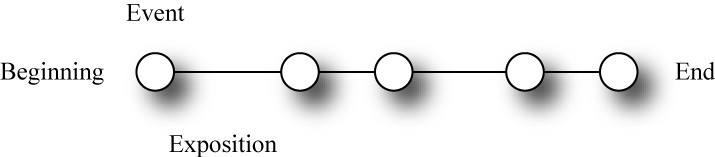
Episodic Narrative is a collective of episodes that tell a story as you watch more episodes more and more is reviled to the viewers. Each episode holds a piece of the puzzle. Another thing that episodic narratives have is a flash back of the last episode at the start of each episode so that you are informed of everything that happened before for example Pramface.

Open and Closed Narrative: Open narratives normally have many characters and no actual ending that we can see clearly for example soap operas such a EastEnders but also they can be mult-stranded and in real time.

Closed Narrative are normally films that last about 60-90 that have a start and end of the story meaning there's no need for a continuation. For example Straight Outta Compton the movie starts the viewer knowing that there going to be an end in that same picture

Realist narratives are narrative that can be based on a real life situations or that can be related to by the audience for example war movies, they so the good and bad side to war but either way it is a real life situation.

Anti realist narratives are narratives that would not exist in real life scenarios such as Dr. Who star war.etc. things that use a lot of special effect and editing which is used to create a more out of this world effect.


Subscribe to:
Posts (Atom)